
OST — Teresa Torres
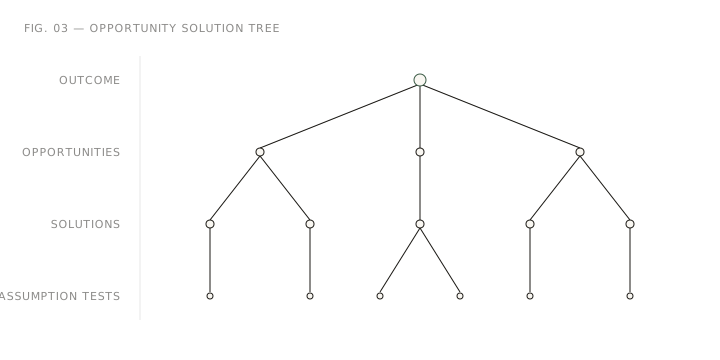
A tree that keeps product thinking honest. Desired outcome at the root, customer opportunities below, solution bets under those, assumption tests at the leaves.
Why it resonates
Most product teams I work with can produce features all day. Fewer can explain which customer opportunity a feature is a bet on, and even fewer can say which assumption the next sprint is actually testing. The Opportunity Solution Tree makes that whole chain of reasoning visible on one page. It turns “why are we building this?” from a hostile question into a navigation tool. Under AI-era discovery conditions — where assumption cycles can be days, not months — the tree becomes sharper still, because it forces the team to stay anchored to the outcome rather than chasing the latest thing a model can do. A good tree is also the artefact that survives translation to the director who was not in the room.
How I’ve used it
With a product group that had a quarterly outcome and seven candidate features, I ran a two-session mapping workshop to rebuild the tree from the outcome down. Three of the features disappeared. Two new opportunities surfaced from customer research that had been sitting unused. The team left with a single A3 artefact their director could read in sixty seconds — which was the first time a roadmap review had taken less than an hour in that group.
— Teresa Torres, Continuous Discovery Habits, (2021).